

A Dubious Science History Lesson
The exclusion of "outsiders" isn't a strategy for scientific success

Last week, I watched a clip of Vice President Vance downplaying concerns about scientific “brain drain.” His remarks came after the administration abruptly paused new federal research grant awards and student visa interviews.
To make his case, Vance referenced the space program:
“If you go back to the ‘50s and ‘60s, the American space program, the program that was the first to put a human being on the surface of the moon, was built by American citizens — some German and Jewish scientists who had come over during World War II, but mostly by American citizens who had built an incredible space program with American talent. This idea that American citizens don’t have the talent to do great things, that you have to import a foreign class of servants and professors to do these things, I just reject that. I just think we should invest in our own people. We can do a lot of good.”
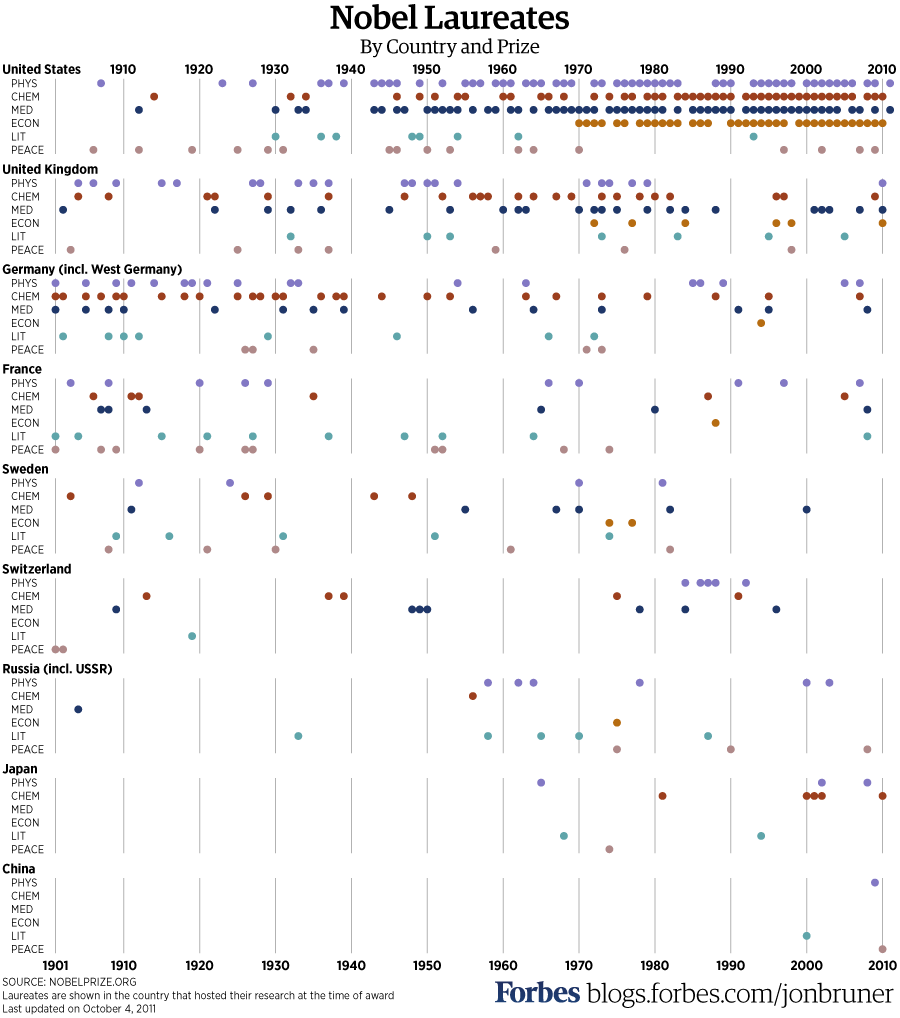
Below is a graphic (created by former data journalist Jon Bruner) of Nobel Prizes by country and year. Notice Germany’s pre-1940 cluster and the United States’ surge once persecuted European scientists began arriving. Draw your own conclusions:
At the very moment I was watching the clip of Vice President Vance, I was also (as part of fact-checking my book) re-reading a paper about teamwork in science and the allocation of credit. The paper shows that, as scientific teams have grown larger in recent decades, the career prospects of junior scientists have gotten worse. The researchers who authored the study argue that there’s a “Matthew effect,” in which the credit-rich get richer, and the poor poorer. Specifically, when junior scientists are part of a large collaboration, their names can get lost. Peers in the field tend to credit the senior names that they already recognize. And among the disadvantaged junior scientists, foreign-born junior scientists are even more disadvantaged.
To me, the subtext of Vice President Vance’s remarks is that foreign scientists have gotten too much credit at the expense of Americans. If anything, it would appear that foreign scientists get the short end of the credit stick. This tracks with my own experience of working in a lab. The lab included a foreign grad student who was plainly brilliant and helped everyone else with their work. But his English wasn’t great, so it was difficult for him to network and present work publicly, which led to less credit than he deserved.
Science thrives by bringing people with disparate ideas and experiences together in shared endeavor. As I wrote in Range, scientists who have worked abroad are more likely to make a big impact than those who have not, perhaps because they help drive what sociologist Brian Uzzi calls the “import/export business of ideas.” When prominent creativity researcher Dean Keith Simonton studied the history of innovation in Japan — which vacillated between being very closed and very open to the rest of the world — he saw that creative explosions in domains from ceramics to medicine followed bursts of immigration.
Science suffers when those viewed as outsiders are excluded. There’s a famous story about David Hilbert, a German mathematician and arguably the greatest of the twentieth century: at a banquet in 1934, Bernhard Rust, the Nazi Minister for Science, Education, and Popular Culture, asked Hilbert if the math department at his university had really suffered any ill effects from the departure of Jews and their sympathetic colleagues. “No, it hasn’t suffered,” Hilbert replied. “It simply doesn’t exist anymore.”1

Thank you for reading. If you found this post interesting, you can share it here:
And if you aren’t subscribed, you can do that here:
Until next time…
David
A.A. Fraenkel, Recollections of a Jewish Mathematician in Germany, Birkhäuser/Springer, 2016.
Nice article and to the point. I would add that when words of the administration can be countered and their own hypocrisy pointed out that needs to be done too. For example, Vance states at his conclusion that “ I just think we should invest in our own people. “ They have no intention of doing that, in fact, he and his criminal cronies are doing the opposite. To invest in our own people, they would need to bolster education- instead they are decimating the Dept. of Education; they would need to continue funding grant research- instead they are removing science and replacing it with fantasy and pseudoscience; I could go on and on. Vance’s statement on this is simply just “flooding the zone” to obfuscate their other equally bad actions.
Great article! Another strong example of the effects of the same brain drain is the atomic bomb--the Nazis did try to invent it, but they'd killed, expelled or driven away everybody who could check Heisenberg's work, so one math error (or "error") doomed the project. Meanwhile, the U.S. recruited its best theoretical physicists from everywhere in the nation, had them all meet up in Los Alamos, whereupon they realized they all knew each other from high school back in Budapest.