

Why (and How) I Wrote This Book
"Mesearch" was a big part of it...

There was a dose of “mesearch” in my book Range. I have expansive curiosity, and I’ve had a zig-zaggy career. There is a far heftier dose of mesearch in Inside the Box.
Very much because of my expansive curiosity, I have been truly terrible at putting helpful boundaries around my own projects. For each of my first two books, I wrote approximately 150% the allotted length for the book, and then had to cut back to the prescribed length. I took a trip to Arctic Sweden for my first book that I had to cut!
Sure, the trip was interesting. But once I became a parent, I absolutely did not want to be writing a book-and-a-half to get a book, or taking trips to Arctic Sweden that didn’t actually fit with the project. In short, I wanted to be more efficient with my time. I also had a coherence problem. One reason I wrote so far over length with my first two books was that I didn’t create a clear enough structural architecture for the book. That meant I didn’t have a great sense of what research and stories were inbounds for the project, and what were out. I fixed a lot of that through multiple drafts, but I don’t think it ever fully disappeared. It remained as a faint palimpsest of disorder underneath the polished surface of the book. I’m always trying to improve at my craft, so I decided to try something different for Inside the Box.
This time around, after doing a lot of research and interviewing, I made a structural outline for the book—on one single page. I wanted to force myself to prioritize the most interesting ideas and to order them in a way that gave greater coherence to the full book than was the case for my previous two. As you can see in the image below, my brain tried to cheat the system by writing microscopically! But this forced me to think about ways to group related ideas. The exercise also led me to a structure in which one story from the introduction reappears throughout the book, each time with a new layer, and each time introducing a set of linked chapters.
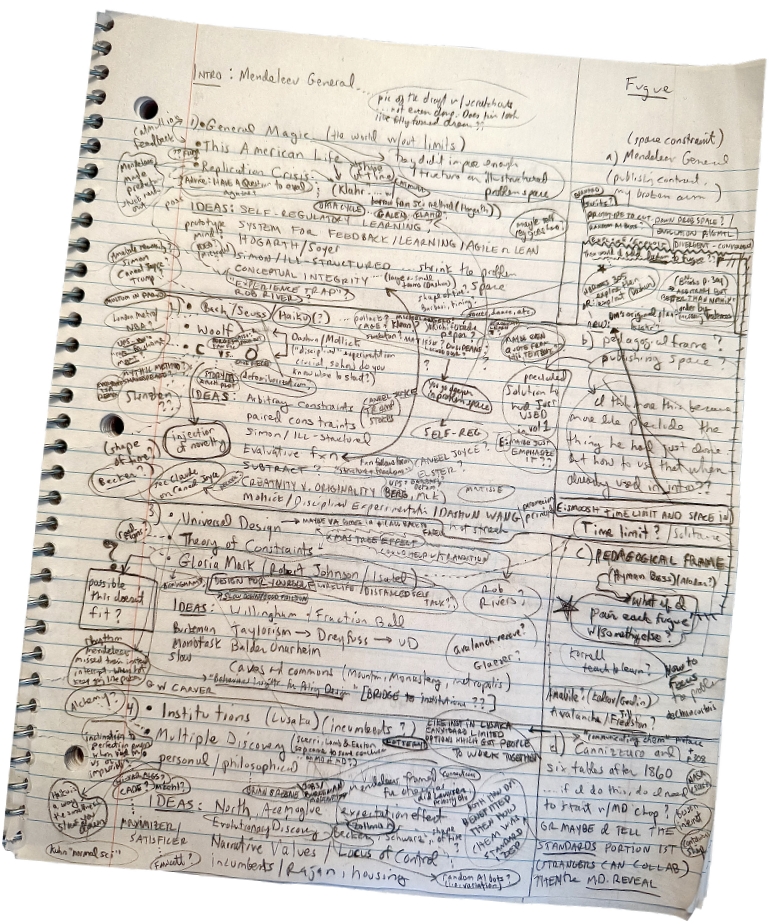
As a consequence, the book is more structurally cohesive than my first two, and 20% shorter. It’s the tightest (and, I think, best) writing I’ve ever done. Plus, this is the first time I wrote a book to get a book, not 150% of a book to get a book!
The one-page exercise was torture, but it was clarifying. As Tony Fadell, cofounder of Nest and an important figure in the book, told me: “With these ultra constraint‑based things, it makes you really think hard. It slows you down, but it forces that thinking.”
Obstacles, whether self-imposed or not, can be opportunities to clarify priorities and launch productive exploration. The one-page outline forced both for me. I had to prioritize ideas ruthlessly. And I had to experiment with a new structure that could make it all work.
If I ever write another book, I would always do it this way. It was a little harrowing after more than a decade of book writing to suddenly have a new process, but a constraint took me somewhere I could not have seen any other way.

Thank you for reading. You can see early blurbs and reviews and preorder Inside the Box here. Publisher’s Weekly recently gave the book a starred review, and said: “Epstein reveals the transformative power of obstacles. It’s a game changer.”
If you have already ordered from any U.S. retailer, you can fill out this form to get exclusive bonus Q&As (including one with Tony Fadell).
Next month, I have several in-person events planned — you can see the full list here. If you come to one, please say hi!
Finally, if you found this post interesting, please consider sharing it.
Until next week…
David
This is exactly the conversation between Jack Carr and David McCloskey on the Jack Carr Danger Close podcast. Both are writers and have completely different processes. McCloskey, a former CIA analyst stated that he will typically write 300,000 words for a 100,000 word book, ( I could be slightly off, but it was something like that). Carr, on the other hand, a former SEAL, does a 1 page summary to get himself going, and then writes the book. As for me, when I write a 1000 word blog post, I typically write 1000 words then correct the whole thing 5-10 times.
This may seem odd, but constraints are one of the things that made coaching college football so challenging and fun. Each job is so much different from a resource perspective, and not having what the haves had (say that three times fast) causes you to be more creative.