


Back when we used to run together on weekends, Malcolm Gladwell shared with me a study about suicide that I found both surprising and important.
I recently shared it with a friend who was struggling, and she found it valuable and shared it widely in turn. And now I want to share it with you, so that you can pass it along should the need ever arise.
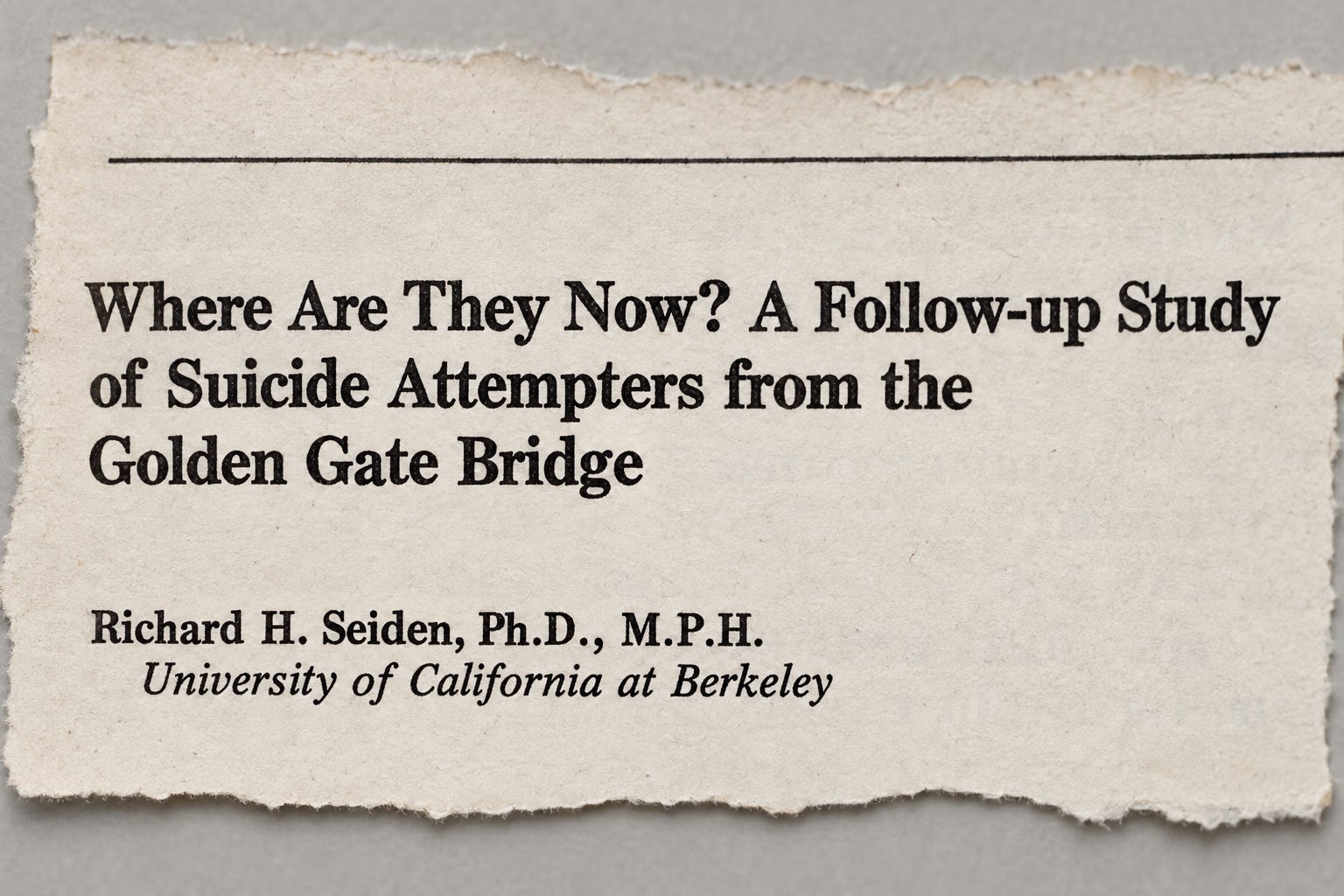
The study, published in 1978, is titled: “Where Are They Now? A Follow-up Study of Suicide Attempters from the Golden Gate Bridge.”
The author, UC Berkeley public-health researcher Richard Seiden, identified 515 people who had been restrained from jumping off the Golden Gate Bridge between 1937 and 1971, and followed what happened to them.
The rather stunning finding is that 452 were still alive years later at the end of the follow-up period. Thirty-one had died of natural causes, and seven from other causes like accidents. Only 25 had died by suicide.
The profound point here is that if the moment of peak desperation is interrupted, most people go on living. Gladwell writes about this in Talking To Strangers. This might seem deeply counterintuitive. If someone really wants to end their life, won’t they just do it the next day, or the next week, or at the next bridge over? Apparently not.
In a 1975 paper, psychiatrist D.H. Rosen interviewed six people who had jumped off the Golden Gate Bridge and actually survived, plus one survivor of a jump off the Bay Bridge. According to the paper, that represented 7 of the 10 known survivors at the time.
Those survivors described various motivations: depression; loneliness; rejection by a lover; failure in school; family problems. But in the interviews several made it clear they had found a new will to live, or were happy that they had survived. There is no long-term follow-up that I know of. But of the seven people Rosen interviewed who had improbably survived jumping from a bridge, only one had attempted suicide again by the time of the study. Again, surviving the most desperate moment was followed by longer-term survival.
As the friend with whom I shared the paper put it: make it through the night. I think there's a smaller version of that lesson for ordinary bad moments, too. The worst of it feels permanent, but usually isn't. You don't have to solve anything in that moment, or figure out what it all means. You just have to get to the other side of it.

Thank you for reading. If you or someone you know is struggling, you can call or text 988 (the Suicide & Crisis Lifeline in the US).
As always, you can subscribe here.
Until next time…
David
As someone who has been to a pretty dark place and gotten to the other side (I hit rock bottom from alcohol abuse), there is an odd gift in the getting all the way to the worst. It actually points in a very clear opposite direction to better. It’s exceedingly hard to see that gift in the moment but it’s there.
I had this realization as well when working with a patient at an intensive treatment center connected with a major hospital early in my career. He was suicidal (very much so) and we were monitoring him very closely. Then he had a heart attack and was transferred to the hospital itself in serious condition. He was fighting for his life and realized that he really wanted to live. I found it fascinating and ironic. He did survive - no longer suicidal at all.