


If there is someone out there with more research at their fingertips than psychologist Adam Grant, I haven’t met them. He is the rare combination of extremely prolific and extremely interesting. (My hypothesis: he has an identical twin sharing the workload. 🤔)
I just tore through his new book, Vibe: The Secret of Strong Connections in a Lonely World.
One of the arresting ideas early in Adam’s new book is that if you make a list of people you consider friends, only about half of those people will list you as a friend. Depressing! Or maybe not… I asked Adam about that, and he wrote a response below that serves as an introduction to this post. Our Q&A is below that, and ends with an excellent lightning round. Adam’s intro:
I used to think it was sad that only about half the people we see as friends view us that way. I’ve changed my mind.
“Friend” is so broad that it’s almost a meaningless term. Some people use it to describe anyone who’s more than an acquaintance. Others reserve it for their inner circle. When we’re not on the same page, we don’t know what to expect from each other. We have more rewarding relationships when we figure out what role different kinds of friends play in our lives.
I’ve found that we need three kinds of people: allies, pals, and companions. Allies are people who share our goals: we’re on a mission together. Pals are people who share our interests and hobbies: we have fun together. Companions are people who share our values: we have deep affection for one another.
The people who don’t think you’re “friends” might not see you as their go-to companion, but they might still count on you as a dependable ally. And there are people you don’t currently consider friends who would love to pal around with you at pickleball or karaoke.
David Epstein: I think we often strive to have a small number of really close friends. Is there value in relationships that aren’t progressing to greater depth?
Adam Grant: You’re more likely to get a job through distant friends than close friends. It’s not just due to numbers; the people you don’t know well are more likely to know about new opportunities and open new doors. Sociologists call it the strength of weak ties. Distant friends are sometimes our best allies.
DE: I am introverted at a giant party, but extraverted with a small team at work. Can you explain what “if-then signatures” are? I find this idea so powerful for understanding my own behavior.
AG: Different situations bring out different sides of us. My favorite example is Dwight Schrute on The Office: if he’s with a subordinate, then he’s domineering, but if he’s with a superior, he’s deferential. If you pay close attention to your own fluctuations, you can start to identify your own “if-then” signatures. And if you notice other people’s patterns, you can help them shape-shift. When our son Henry was in elementary school, he was afraid to ski down a steep hill. I noticed that he was timid with his older sisters but brave with his friends, so I invited one of his pals to ski with us. It only took one warmup run before Henry was racing down a black diamond and challenging his pal to follow him.
DE: There are a lot of hilarious and illuminating graphics in the book. My favorite shows a text message:
“Do you wanna be in cahoots with each other…I don’t have a specific scheme in mind but I think it would be fun to be in cahoots.”
What’s the significance of this?
AG: In romantic relationships, we have norms to define our status. Baby Boomers said we’re going steady. Millennials and Gen Z are official or in a situationship. For me, ‘Do you want to be in cahoots’ is a lighthearted way to signal that you want to be allies and pals with someone.
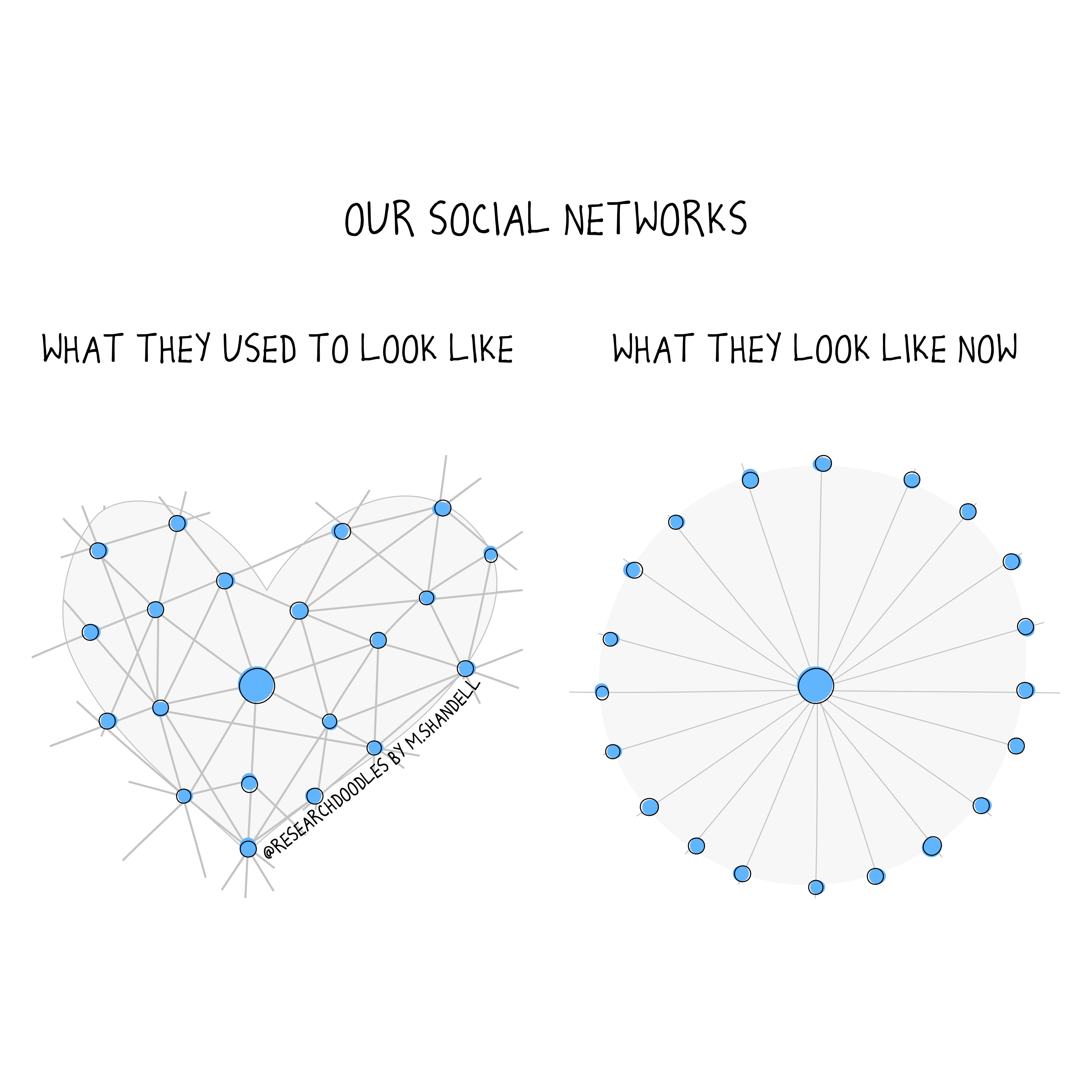
DE: How often do we need to make contact with friends in order to maintain closeness?
AG: If you don’t communicate at least once every 17 days, you’re toast.
In all seriousness, we can’t put a precise number on it, but we don’t need to be in touch as often as we think. Strong bonds can survive months or even years of distance. It’s common, though, for people to mistake a lapse in communication for a lack of care. To prevent misunderstandings, it’s helpful to clarify our expectations. I’ve started letting people know that even if a long time passes, I’ll still care about them and be delighted to hear from them.
DE: You’re like a tenth-degree black belt in icebreakers, for individuals and groups. What’s a piece of advice you can give us for breaking the ice?
AG: Skip the small talk and go right into pal mode. One of my favorite icebreakers is, Is a hot dog a sandwich? People immediately start riffing and laughing, and sometimes they even bond over creative solutions. You got to experience that one recently at an event I hosted, and I loved your resolution: a hot dog is a taco. You had me at taco, David Epstein.
DE: Glad to be of service…
There’s a fascinating part in the book about the Olympics. You note that research has found that—despite the Olympic mission to promote solidarity—viewers actually become more hostile to other countries during the Games. But that research is on the TV audience. I’ve been to the Olympics, and you’ve been, and in person it’s the opposite. There actually is a great feeling of solidarity. Why the difference, and what does this tell us about how we might promote a little more solidarity in the world?
AG: It’s easy to cling to stereotypes and prejudice from afar. When you’re watching from your couch, other countries are distant enemies. In person, there are rituals for interacting like pals and allies. You eat together and party together and even celebrate moments of triumph together. In Paris, we found ourselves sitting next to complete strangers from Europe, and we were all rooting for the Mexican divers. We became part of a global community of sports fans who were more committed to witnessing greatness than victory. I think the lesson is that common identities are often hidden in plain sight. It didn’t take much to humanize the fans from other countries; all we needed was to feel joy at the same event. Identifying as a sports fan doesn’t stop me from being proud of my country—and it reminds me not to hate other countries.
DE: It was interesting to read about a conflict you had with Brené Brown—a disagreement in how you interpreted her words about authenticity. You didn’t speak for years, but you ended up hosting a podcast together! It reminded me of my interactions with Malcolm Gladwell and Angela Duckworth. We never had a falling out like you and Brené, but in both cases my first interaction with them was a public disagreement or debate of some sort. Today, they are truly two of my favorite people in the world to talk to. So what is something that you and I might have gotten right that allowed this?
AG: Some of the people we end up liking the most are the ones we started out disliking. Respectful disagreement can bring us closer together—it signals that we care enough about one another’s opinions to put energy into trying to change them. And to overcome the cognitive dissonance of feeling affection for former adversaries, we end up convincing ourselves that we were wrong about them.
⚡⚡LIGHTNING ROUND⚡⚡
DE: I share a phrase, and you react.
“Never go to bed angry.”
AG: If you never go to bed angry, you’re always fighting when you’re angry and tired.
DE: “Opposites attract.”
AG: Empirically false. We’re more attracted to people who remind us of ourselves—there’s even research showing that we gravitate toward people who smell like us.
DE: “Birds of a feather flock together.”
AG: They may flock together, but they don’t always stick together. Extensive evidence shows that feeling similar—not being similar—is what sustains friendships and marriages too.
DE: Why do people rarely mix at mixers?
AG: They’d rather hang out with their wingman or wingwoman than risk the awkwardness and embarrassment of talking to strangers.
DE: Why are running clubs better than dating apps?
AG: I knew you’d find a way to work in a running plug! When your hearts are racing together, you’re more likely to bond together. Sweating together is social grease. Plus, if the date sucked, at least you still got a run in.
DE: “Brutally honest.”
AG: To paraphrase Bob Burg, people who take pride in being brutally honest are mostly interested in being brutal. Be direct in what you say but kind in how you say it.
DE: Standing up for meetings at work.
AG: Experiments have shown that if you stand up, meetings are shorter—and just as effective. As their feet get tired, people stop bloviating.
DE: Research shows that jerks online are _____ IRL.
AG: Jerks IRL too. The difference is that aggression is ostracized offline but amplified online.
DE: Sandwich critical feedback between positive comments.
AG: It’s time to take the feedback sandwich off the menu; it doesn’t taste as good as it sounds. It’s more effective to just tell people you have comments on areas of both strength and growth and ask which one they want to hear first.
DE: Better sign for a relationship: starting with an intense spark or falling in love gradually?
AG: Empirically, falling in love gradually is at least as good. It often takes time to discover and develop compatible goals, interests, or values.
DE: Seek all kinds of emotional support from a good friend or different kinds of emotional support from a variety of friends?
AG: A variety of friends. On average, people have higher well-being when they go to different people as allies, companions, and pals rather than trying to put all their eggs in one basket.
DE: Smaller class sizes are always better.
AG: False… in fact, they’re often worse when it comes to belonging. Across studies of over 25,000 elementary and middle school kids, bullying turns out to be more common in smaller classes—bullies have more power and victims have less support.

Thank you to Adam for his time, and thank you for reading. Vibe: The Secret of Strong Connections in a Lonely World is hot off the presses.
If you appreciated this post, please share it. That’s the only way this reader-supported newsletter spreads.
And if a friend sent this to you, please consider supporting Range Widely with a free or paid subscription.
Lastly, I know I haven’t been responding to quite as many comments lately. I still read every single one and respond regularly.
Until next time…
David
Thank you, David! As always, your questions were both thought-provoking and fun. I'm getting ally and pal vibes...
I found this a very interesting read as I've always prioritized connection and have done a lot of thinking about how important it's been in my life and how it's helped me, especially in this stage of my life. feel like I have a wonderful community. I do think this is skewed though to a male perspective. In my experience, women's friendships are more core and while there are degrees, the iterations of pal, etc. aren't thought about or experienced in the same way.